If you’re between 35 and 55, you’ve probably noticed something:
The same workouts that once leaned you out now just maintain you.
Recovery takes longer.
Sleep matters more.
Stress shows up in your waistline.
This isn’t a lack of discipline. It’s physiology interacting with lifestyle load.
The mistake most people make is assuming the solution is to “try harder.” In reality, the model has to evolve. Below is a structured breakdown of what changes at 35, 45, and 55 ( hormonally, neurologically, metabolically, and behaviorally, and how training should adapt at each stage.)
Age 35: The Silent Shift
For many high-performing professionals, 35 is not a dramatic collapse. It’s subtle. That’s why it’s dangerous.
1. Testosterone and Hormonal Environment
Total testosterone in men declines roughly 1% per year starting in the early 30s. More importantly, free testosterone may drop faster due to rising SHBG (sex hormone-binding globulin). Free T is what actually interacts with tissue.
Lower free testosterone affects:
- Muscle protein synthesis efficiency
- Recovery speed
- Drive and competitiveness
- Fat distribution (more central storage)
In women, perimenopausal hormonal variability can begin as early as the late 30s, with fluctuating estrogen and progesterone affecting sleep, mood, and body composition.
This doesn’t mean you can’t build muscle at 35. It means the margin for error shrinks.

2. Recovery Capacity Is No Longer Automatic
In your 20s, you could:
- Sleep 5 hours
- Drink on Friday
- Train hard Saturday
- Recover by Monday
At 35, recovery becomes a managed resource.
Physiologically:
- Growth hormone secretion during deep sleep becomes more sensitive to sleep duration.
- Cortisol response to stress becomes more impactful on abdominal fat storage.
- Connective tissue recovery slows slightly.
This is the age where sleep debt accumulates as visible softness.
3. NEAT Declines Without You Noticing
NEAT (Non-Exercise Activity Thermogenesis) often decreases because:
- You’re more desk-bound.
- You delegate physical tasks.
- You drive more.
- You are cognitively exhausted.
Two people can both “train 1 hour,” but the one with lower NEAT burns 300–500 fewer calories per day.
That difference alone explains why the same diet no longer works.
What Training Should Look Like at 35
- 3–5 resistance sessions per week
- Progressive overload, but controlled volume
- Prioritize sleep over adding more cardio
- Structured protein intake (~0.7–1g per lb bodyweight)
- Strategic carbohydrate timing around training
At 35, optimization beats intensity.
Age 45: The Stress–Recovery Equation Becomes Central
At 45, lifestyle stress is often at its peak.
Career pressure.
Financial responsibility.
Teenage children.
Travel.
Aging parents.
Physiology now interacts strongly with chronic stress exposure.
1. Cortisol Dominance and Central Fat Storage
Chronic psychological stress elevates baseline cortisol.
Cortisol:
- Promotes visceral fat deposition
- Impairs sleep quality
- Reduces insulin sensitivity when chronically elevated
- Increases muscle protein breakdown
This is why many people at 45 feel like they “train hard but look softer.”
It’s not effort. It’s endocrine context.
2. Insulin Sensitivity Becomes Behavior-Dependent
In your 20s, poor sleep and high carbs might not visibly affect you.
By 45:
- Sleep restriction impairs glucose tolerance.
- Sedentary days reduce GLUT4 activity in muscle.
- High stress amplifies post-meal glucose spikes.

Insulin resistance is not inevitable at 45, but it becomes easier to develop if lifestyle is unmanaged.
Resistance training becomes non-negotiable here.
Muscle is your largest glucose disposal organ.
3. Muscle Mass Loss Accelerates If Unchecked
Sarcopenia (age-related muscle loss) begins gradually in your 30s but becomes more noticeable in the 40s.
Without resistance training:
- 3–8% muscle loss per decade
- Reduced resting metabolic rate
- Increased fat gain with stable calories
Most people blame metabolism. In reality, it’s muscle mass.
4. Joint Integrity and Volume Tolerance
Collagen turnover slows with age.
High-volume training that once felt energizing now causes:
- Tendon irritation
- Persistent inflammation
- Delayed onset soreness lasting longer
This is where intelligent programming separates results from frustration.
What Training Should Look Like at 45
- 3–4 heavy resistance sessions weekly
- Lower junk volume, higher intent
- 1–2 low-intensity cardio sessions (Zone 2)
- Deload weeks every 4–6 weeks
- Sleep minimum 7 hours
- Periodized nutrition (avoid chronic aggressive dieting)
At 45, sustainability is a performance variable.
Age 55: Preservation, Power, and Metabolic Resilience
At 55, the conversation shifts from optimization to preservation of function and power.
The goal is no longer aesthetics alone. It’s:
- Bone density
- Neuromuscular coordination
- Hormonal resilience
- Independence

1. Testosterone, Estrogen, and Menopause/Andropause
By 55:
- Men often have significantly reduced free testosterone.
- Women may be postmenopausal, with lower estrogen levels.
Lower estrogen in women:
- Reduces bone density
- Alters fat distribution
- Increases cardiovascular risk
Lower testosterone in men:
- Reduces muscle protein synthesis efficiency
- Decreases red blood cell production
- Reduces recovery capacity
Training now becomes medical prevention.
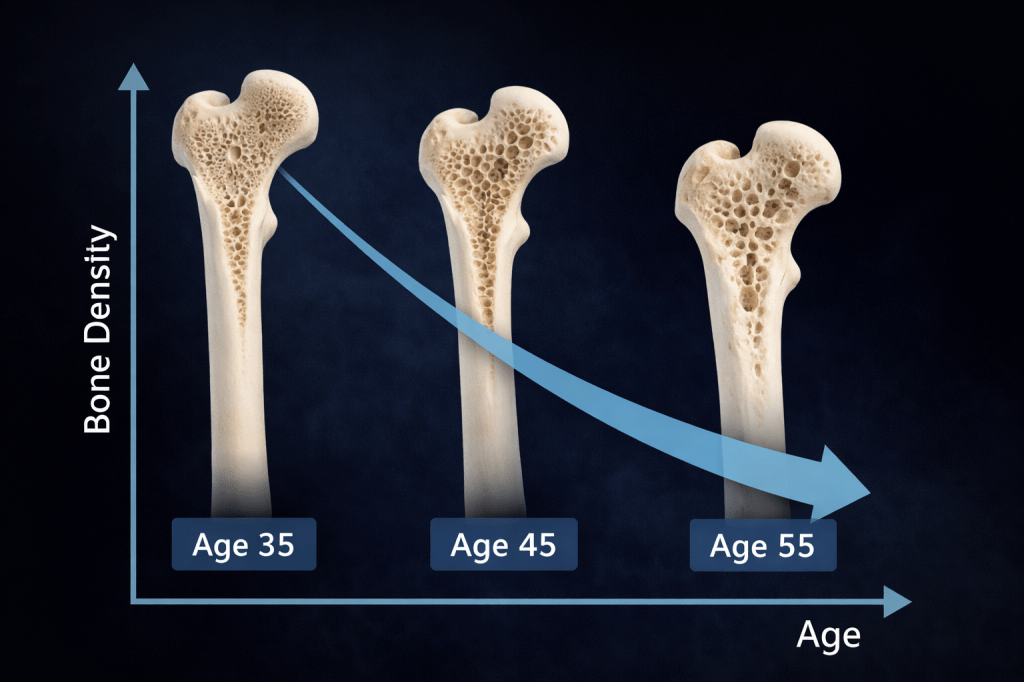
2. Bone Density and Mechanical Loading
After 50, bone mineral density declines faster without mechanical stimulus.
Resistance training:
- Stimulates osteoblast activity
- Preserves bone strength
- Reduces fracture risk
Walking alone is insufficient for this purpose.
You need load.
3. Power Loss Is Faster Than Strength Loss
Research shows that power (force × velocity) declines faster than raw strength.
This is critical because power is what prevents falls.
Training should include:
- Controlled explosive movements (e.g., medicine ball throws, fast concentric phases)
- Step-ups with speed emphasis
- Moderate-load compound lifts
Carefully dosed, not reckless.
4. Mitochondrial Efficiency
Mitochondrial density declines with age unless stimulated.
Zone 2 cardio:
- Improves mitochondrial biogenesis
- Enhances fat oxidation
- Improves metabolic flexibility
At 55, metabolic flexibility becomes protective against diabetes and cardiovascular disease.
What Training Should Look Like at 55
- 3 resistance sessions weekly (full-body emphasis)
- Prioritize compound movements
- Include controlled power work
- 2 Zone 2 sessions
- Higher protein intake (~1g per lb lean mass)
- Longer recovery windows between intense sessions
At 55, training is an investment in independence.
The Real Problem Isn’t Age. It’s Using a 25-Year-Old Model at 45.
Here’s the uncomfortable truth:
Most training programs on social media are built by:
- People under 30
- People without children
- People without executive stress
- People with 2–3 daily training windows
- People whose job is their body
Trying to replicate that while running a business, traveling, raising children, and managing stress is physiologically mismatched.
That mismatch creates:
- Overtraining
- Chronic dieting
- Hormonal dysregulation
- Burnout
Age doesn’t require less discipline.
It requires better alignment.
The 4 Pillars That Matter From 35–55
Across all stages, four variables dominate results:
1. Muscle Mass Preservation
Your metabolism is largely determined by lean mass.
If you maintain muscle:
- You maintain metabolic rate.
- You maintain insulin sensitivity.
- You maintain functional capacity.
2. Sleep Quality
Sleep affects:
- Testosterone
- Growth hormone
- Insulin sensitivity
- Cortisol regulation
- Appetite hormones (ghrelin and leptin)
Sleep is anabolic infrastructure.

3. Stress Regulation
Chronic psychological stress alters body composition more than most people realize.
You cannot out-train a chronically elevated stress state.
4. Nutrition Periodization
Chronic aggressive calorie deficits elevate cortisol and reduce thyroid output.
Strategic calorie cycling and diet breaks preserve hormonal function.
Why Results Feel Slower
After 35, visible changes take longer because:
- Muscle protein synthesis is slightly less responsive.
- Recovery between sessions takes longer.
- Sleep debt accumulates faster.
- Lifestyle variability is higher.
This doesn’t mean progress is impossible.
It means stimulus must be precise.
Final Perspective
At 25, your body forgives.
At 35, your body negotiates.
At 45, your body reflects your stress load.
At 55, your body reveals your long-term strategy.
If you align training with physiology and lifestyle, you can:
- Build muscle in your 40s
- Maintain athleticism in your 50s
- Improve metabolic health at any stage
Age is not the enemy.
Misaligned programming is.
The individuals who look strong, lean, and athletic at 45 and 55 are not genetically superior.
They respect recovery, train with intent, manage stress, and stop chasing models that don’t match their life.
That shift from effort to alignment is what changes everything.
If you want help structuring your training around your real life, apply here:
www.delanoteam.com

 Delano Pinheiro