Categoria: Nutrição

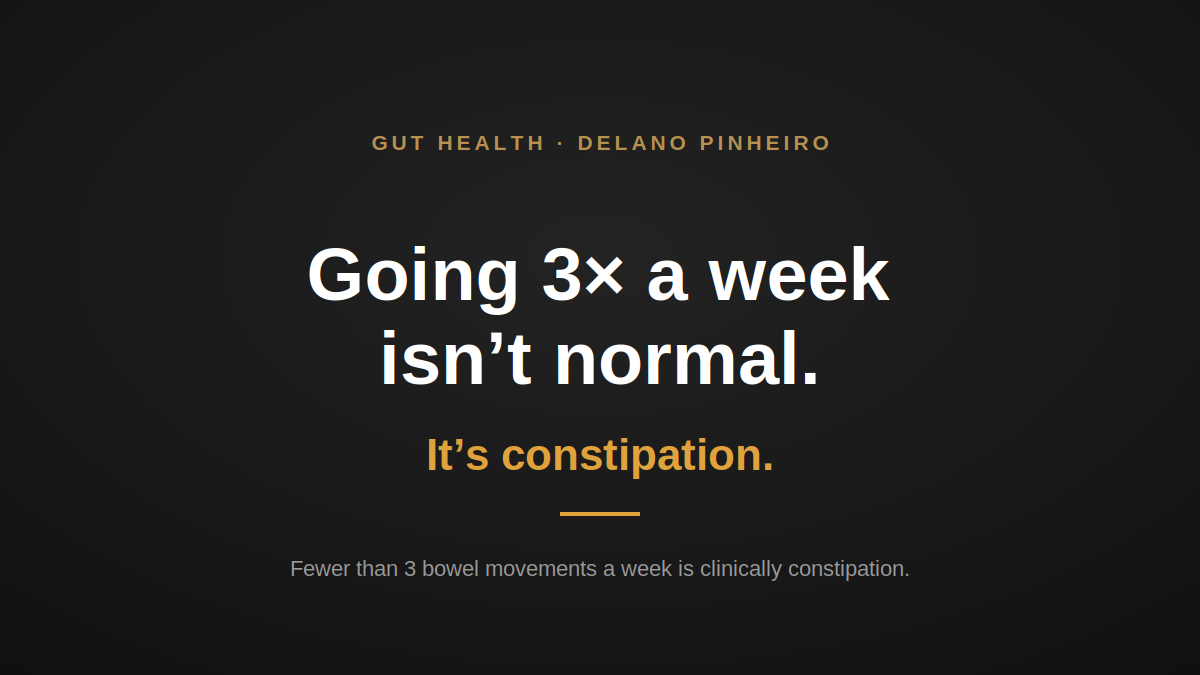
  • Going to the Bathroom 3 Times a Week Isn’t Normal!

    Going to the Bathroom 3 Times a Week Isn’t Normal!

    What almost no one told you about how your gut actually works, and why it’s draining your energy in the middle of your day.

    “But that’s just how my body works.” If you’ve ever said that about going to the bathroom only a few times a week, give me the next five minutes, because that “just how it is” is exactly the problem. Going three times a week isn’t your natural rhythm. It’s a gut that has gotten used to running badly.

    First, what “normal” actually means

    Clinically, having fewer than 3 bowel movements a week is already constipation, even if it feels completely normal to you. But here’s the point that changes everything: “not constipated” is not the goal. Scraping by at the bare minimum is surviving, not functioning well.

    The healthy range is wide: anywhere from 3 times a week to 3 times a day. But for most adults, the sweet spot, the one that keeps your energy and digestion steady, is close to once a day.

    And it’s not just the number. Just as important as frequency is quality: firm, complete stools, passing without straining, with the sense that you actually emptied. Going every day but with effort, hard and dry and feeling like something’s left behind, is also a red flag.

    Why this matters (especially if your calendar is full)

    A sluggish gut isn’t just discomfort in the bathroom. It’s a tax you pay all day long, often without connecting the dots:

    • Less energy: stalled digestion drains resources and slows you down right when you need to perform.
    • Bloating and a heavy, distended belly by the end of the day, even when you barely ate.
    • That feeling of “weight” and discomfort in the middle of a meeting or an important moment.

    In other words: a detail you treat as trivial is quietly charging a toll on your energy and your productivity.

    Why “it’s always been like this” is the trap

    Your body adapts to what you repeat. When the gut spends months (or years) working slowly, that becomes the new baseline, and the baseline starts to feel normal. Getting used to something isn’t the same as it being healthy. The fact that you’ve adapted doesn’t mean everything is fine; it means the fix is overdue.

    What does NOT fix it: the trendy laxative tea

    I’ll be blunt, because there’s a lot of money riding on this misinformation. Laxative teas don’t cure constipation. That “relief” you feel is the gut being chemically forced, not corrected. Use it for a while and it gets lazy without the stimulus, and you build a dependence on the product to do what your body should do on its own.

    Real constipation is almost never a lack of tea. And in the vast majority of cases, it isn’t a lack of medication either. It’s a lack of the basics, the stuff nobody sells, because you can’t package it in a pretty capsule.

    What actually fixes it: fiber, water, and movement (in the right dose)

    Less sexy than a “miracle detox,” I know. But it’s what works and holds up long term, with no rebound effect:

    Fiber on your plate. Fruit, vegetables, legumes, and whole grains throughout the day. Fiber gives your gut bulk and rhythm. Increase it gradually so you don’t bloat in the process.

    Water, spread out. Fiber without water does nothing: water is what keeps things soft enough to pass without strain. Drink across the day, not all at once.

    Daily movement. You sit for 8 hours and your gut sits right along with you. Movement is a natural laxative, and it’s free. You don’t need a marathon: walking, getting up from your chair a few times a day, and training consistently already move the needle.

    Three simple things that fit into your week. What fixes this isn’t a burst of intensity. It’s consistency.

    When to see a professional

    Adjusting your habits solves most cases, but not all. Seek medical advice if you notice: a sudden and persistent change in your bowel habits, blood in your stool, severe abdominal pain, unexplained weight loss, or constipation that doesn’t improve even with the changes above. This article is informational and does not replace an individual evaluation.

    If you want the practical playbook (how much fiber, how to spread your water, and what movement fits a packed schedule), I put together a quick 5-minute guide.

    👉 Download the free guide here: [GET THE GUIDE HERE]

    Delano Pinheiro is a certified physical education professional specializing in sports nutrition, injury prevention, and body composition change. In 10 years, he has helped more than 11,000 people train efficiently and sustainably, without becoming athletes and without living at the gym. Brazilian, based in Miami.

  • How many meals should I eat to get shredded and gain more muscles?

    How many meals should I eat to get shredded and gain more muscles?

    If you’re trying to burn more fat, build muscle, or simply maintain a healthy diet, it’s important to figure out the number of meals that best suits your profile.

    The number of meals we should have per day depends on various factors, such as activity level, calorie needs, work routine, and individual goals.

    As a result, there’s no one-size-fits-all answer; the number of meals varies from person to person.

    In this post, we’ll discuss some key points to help you decide how often you should eat each day.

    Phase 1. Analyzing Your Profile

    Analyzing the student’s profile is the first step, which is crucial to better understand what this individual has been consuming throughout the day.

    To do this, some important questions are:

    • What foods have you been frequently consuming on a daily basis?
    • Are you consuming a lot of carbohydrates throughout the day?
    • Are you getting the right amount of protein?
    • Are you following a specific diet or at least attempting to?
    • How is your consumption of sweets?
    • Alcohol on the weekends?

    Caloric Expenditure and TDEE

    As we can see, the question of how many times one should eat per day is highly variable and depends on a thorough assessment of each person, tailored to their needs.

    For example, my students have achieved excellent results by following a routine of three to five daily meals.

    However, to determine the correct amount of calories to be consumed throughout the day, it’s necessary to take into account each individual’s Total Daily Energy Expenditure (TDEE).

    This analysis of TDEE in nutrition is essential to determine the ideal number of meals for each person.

    TDEE consists of the basal metabolic rate, which is the number of calories burned throughout the day to keep the body alive, and the additional energy expenditure from physical activities and other daily activities.

    Once you know the correct TDEE for each individual, you can adjust the number of meals according to their nutritional needs.

    Furthermore, the number of meals should also be adapted to meet each person’s goals, whether it’s maintaining, gaining, or losing weight.

    It’s important to remember that, regardless of the number of meals, they should contain important nutrients to maintain proper bodily function.

    Phase 2 – Strategy

    After analyzing these basic pieces of information, we can move on to analyzing which strategy to use, such as caloric deficit, caloric surplus, or caloric maintenance.

    Next, we can examine which dietary style would be best for you based on your goals, needs, and routine.

    With this analysis, you can get an idea of how many pounds you might lose or gain after a few weeks and months.

    Low Carb Diets, Intermittent Fasting, Ketogenic Diet

    Some people might feel fine with only one meal a day, but is that the most effective strategy? Our bodies tend to adapt to the eating routines we provide them.

    Someone who eats only once a day might experience a slowed metabolism over time.

    There are various dietary styles and strategies that can be used in a diet. The first step is to analyze which one aligns best with your profile.

    Much is said about low-carb and intermittent fasting, but these strategies are not suitable for everyone.

    Intermittent fasting, when followed for more than three months, can actually slow down metabolism, as our bodies tend to get accustomed to the stimuli we give them.

    If you’re eating two meals a day, your body will likely slow down its metabolism and might even store more fat. Yes, you read that right.

    I could delve deeper into this, but I’ll just mention that this is a common occurrence, and I see many people coming to me with this issue.

    Some people need to eat more in order to lose weight. Can you believe that? In practice, this happens quite often.

    Intermittent Fasting and Other Strategies

    It’s extremely important to examine strategies like intermittent fasting, as they can be extremely beneficial for health, depending on the case.

    Intermittent fasting holds promise, as it has the potential to improve metabolic health, reduce inflammation, and enhance insulin sensitivity.

    Furthermore, it has also been associated with mental health benefits, and preliminary studies suggest that intermittent fasting might contribute to improved longevity.

    For these reasons, it’s important to assess whether intermittent fasting is suitable for an individual based on their lifestyle, eating routine, and nutritional needs.

    One should consult a nutritionist before starting any intermittent fasting strategy to maximize its benefits.

    When done correctly, intermittent fasting can help improve overall health and well-being.

    In the medium to long term of fat burning, you need to keep your body in a state of high caloric expenditure. The best way to achieve this is by training effectively and providing the necessary nutritional support.

    I see many people eating only once a day, unable to further reduce their weight, and still not engaging in strength training. This is a recipe for a slow metabolism, flabbiness, nutritional deficiency, and more.

    With a professional who analyzes the best strategy, you can fully benefit from what each option offers.

    Low carb follows the same principle, and it’s not the most efficient strategy for people aiming to gain more muscle mass.

    Regarding intermittent fasting, I believe it can be a great short- to medium-term strategy, but as a long-term approach, I don’t think it’s the best. I’ll explain below.

    If someone is fasting, it’s likely because they want to lose weight, burn more fat. For more effective fat burning, you need to increase muscle mass, and to do that, you need to provide more nutrients to your body, which will require eating more than once or twice a day.

    So, how many meals are necessary for those looking to cut fat or gain muscle mass?

    In conclusion, individualization is key.

    Now that I’ve explained a bit more about these strategies, I can share my opinion on this topic.

    For Weight Loss I recommend at least 3 meals a day.

    For more Definition without losing muscle volume, a person should aim for around 4 to 5 meals a day.

    For gaining more muscle mass, that person should eat 4 to 6 times a day.

    Of course, even within these three goals, the number can vary. Once again, it depends on each individual’s uniqueness.

    What I’ve mentioned here is the basics before you embark on a nutritional plan, which means that above all, you need to consider these points; otherwise, your diet won’t align with your goals.

    If you have further questions about improving your diet, feel free to message me.

    If you want a guide to decreasing bloating and water retention, you should definitely check out my detox guide. I created the best strategy for you to follow for 10 days. Super easy and practical to make you lose up to 10 kilos. Here’s the link: 10 DAYS DETOX GUIDE

  • Quantas refeiçōes se deve ter pra secar gordura ou ter mais hipertrofia?

    Quantas refeiçōes se deve ter pra secar gordura ou ter mais hipertrofia?

    Se você está tentando queimar mais gordura, aumentar massa muscular ou simplesmente manter uma dieta saudável, é importante descobrir a quantidade de refeições que melhor se adequa ao seu perfil.

    A quantidade de refeições que devemos ter por dia é dependente de diversos fatores, como nível de atividade física, necessidade calórica, rotina de trabalho e objetivos específicos de cada pessoa.

    Por isso, não existe uma resposta única que sirva para todos, a quantidade de refeições varia de pessoa para pessoa.

    Neste post, vamos discutir alguns pontos importantes para ajudar você a decidir quantas vezes você deve comer por dia.

    Analisando o seu perfil

    A análise do perfil do aluno é a primeira etapa, é fundamental para entender melhor o que essa pessoa vem comendo ao longo do dia.

    Para isso, algumas perguntas são importantes, como:

    • Quais alimentos você tem consumido frequentemente no dia a dia?
    • Consome muito carboidrato ao longo do dia?
    • Consome a quantidade de proteína adequada?
    • Está seguinte alguma dieta específica ou pelo menos tentando?
    • Como está o consumo de doces?
    • Álcool nos finais de semana?Gasto calórico e TDEEComo podemos ver, a questão de quantas vezes se deve comer ao dia é muito variável e depende de uma avaliação minuciosa de cada pessoa, de forma individualizada.Meus alunos, por exemplo, têm alcançado excelentes resultados ao seguirem uma rotina de três a cinco refeições diárias.Porém, para entender a quantidade certa de calorias a serem consumidas ao longo do dia é necessário levar em consideração o Gasto Total de Energia Diário (TDEE) de cada indivíduo.Essa análise de TDEE na nutrição é essencial para determinar a quantidade de refeições ideais para cada um.O TDEE é composto pelo metabolismo basal, que é a quantidade de calorias queimadas ao longo do dia para manter o corpo vivo, e pelo gasto de energia adicional decorrente de atividades físicas e outras atividades diárias.Quando se conhece o TDEE correto para cada indivíduo, é possível ajustar o número de refeições de acordo com as necessidades nutricionais de cada um.Além disso, o número de refeições também deve ser adaptado para atender aos objetivos de cada pessoa, seja para manter o peso, ganhar ou perder peso.É importante lembrar que, independentemente do número de refeições, é necessário que elas contenham nutrientes importantes para manter o bom funcionamento do corpo.

    Fase 2

    Depois de analisar essas informações básicas, podemos passar para a analise de qual estratégia usar, como por exemplo: déficit calórico, superávit calórico, manutenção calórica.

    Em seguida podemos analisar qual seria o melhor estilo alimentar para voce de acordo com o seu objetivo, necessidade e rotina.

    Com essa analise podemos ter uma noção de quantos quilos você poderá eliminar ou ganhar após algumas semanas e meses

    Dietas Low Carb, Jejum Intermitente, Cetogênica

    Algumas pessoas podem se sentir bem somente com uma refeição por dia, mas será que essa é a estratégia mais eficaz? Nossos corpos tendem a se ajustar às rotinas alimentares que lhes fornecemos.

    Uma pessoa que se alimenta somente uma vez por dia, com o tempo, pode ver seu metabolismo desacelerar.

    Existem diversos estilo alimentares e estratégias que podem ser usados em uma dieta, o primeiro passo é analisar qual melhor se encaixa no seu perfil.

    Muito se fala da low carb e do jejum intermitente, mas essas estratégias não são para todos.

    O jejum intermitente quando seguido por mais de 3 meses acaba desacelerando o metabólicos, pois nosso corpo tende a se acostumar com o estimulos que damos a ele.

    Se você esta fazendo 2 refeições por dia, provavelmente o seu corpo irá desacelerar seu metabolismo e até mesmo estocar mais gordura. Sim. É isso mesmo que voce leu.

    Podia ir fundo falando sobre isso, mas vou apenas citar que é super comum isso acontecer e vejo muitas pessoas chegando ate a mim com esse problema.

    Algumas pessoas precisam comer mais para poder perder peso. Acredita? Na prática isso acontece muito

    Jejum Intermitente e outras estratégias

    É extremamente importante examinar estratégias como o jejum intermitente, pois elas podem ser extremamente benéficas para a saúde, dependendo do caso.

    A prática de jejum intermitente é muito promissora, pois tem o potencial de ajudar a melhorar a saúde metabólica, ajudar a reduzir a inflamação e melhorar a sensibilidade à insulina.

    Além disso, também tem sido associado a benefícios para a saúde mental e estudos preliminares sugerem que o jejum intermitente pode ajudar a melhorar a longevidade.

    Por esses motivos, é importante analisar se o jejum intermitente é adequado para a pessoa, com base em seu estilo de vida, rotina alimentar e necessidades nutricionais.

    A pessoa deve consultar um nutricionista antes de iniciar qualquer estratégia de jejum intermitente, para que possa obter o máximo de benefícios da prática.

    Se feito corretamente, o jejum intermitente pode ajudar a melhorar a saúde e o bem-estar geral.

    No processo de médio longo prazo da queima de gordura, você precisa manter o seu corpo em alto estado de queima calórica. E a melhor maneira é treinando de forma eficiente e dando o aporte nutricional necessário.

    Vejo muitas pessoas comendo 1 vez por dia, não conseguindo baixar mais o peso e ainda sem praticar musculação. Essa é a receita certa para uma metabolismos lento, flacidez, deficiência nutricional e muito mais.

    Dito isso, com um profissional que analise a melhor estratégia você poderá se beneficiar totalmente do que cada opção lhe oferece.

    A low carb segue o mesmo principio, e para pessoas que tem o objetivo de ganhar mais massa muscular não é uma estratégia mais eficiente.

    Ainda sobre o jejum intermitente, acredito que pode ser uma ótima estratégia a curto e médio prazo, mas para ser seguido por uma pessoa por muito tempo, não acho que é a melhor a ser seguida. Explicarei abaixo.

    Se alguém esta fazendo jejum é porque provavelmente quer emagrecer, queimar mais gordura. Para ter maior eficiência na queima de gordura você precisa aumentar a massa muscular e para aumentar massa muscular, você precisara fornecer mais nutrientes pro seu corpo, o que vai demandar comer mais que 1 ou 2x ao dia.

    Então, qual é a quantidade de refeições necessárias para quem quer secar ou aumentar massa muscular?

    Para concluir, é preciso individualizar os casos.

    Agora depois de ter explicado um pouco mais sobre essas estratégias eu posso dar a minha opinião a respeito disso.

    Para emagrecer eu recomendo que uma pessoa faça no mínimo 3 refeições por dia.

    Se o objetivo é definir, mas não necessariamente emagrecer, essa pessoa deve comer em torno de 4 a 5 refeições por dia.

    Para ganhar massa mais massa muscular, essa pessoa deverá comer de 4 a 6 vezes por dia.

    É claro que mesmo assim para esses 3 objetivos esse número pode-se variar, mais uma vez, vai depender da individualidade de cada pessoa.

    O que eu citei aqui é o básico antes de você seguir um planejamento nutricional, o que significa que antes de tudo, você precisa analisar esses pontos citados, caso o contrário a dieta não estará de acordo com o seu objetivo.

    Se você tiver mais alguma duvida sobre como melhorar a sua alimentação,  me manda uma mensagem. 

    As inscrições para a consultoria de treinos estão abertas, nela você tem um planejamento exclusivo feito especialmente para as suas necessidades e objetivos. Entre para o meu time de alunos e veja os resultados de ter um planejamento acima da média. www.delanofit.com