What almost no one told you about how your gut actually works, and why it’s draining your energy in the middle of your day.
“But that’s just how my body works.” If you’ve ever said that about going to the bathroom only a few times a week, give me the next five minutes, because that “just how it is” is exactly the problem. Going three times a week isn’t your natural rhythm. It’s a gut that has gotten used to running badly.
First, what “normal” actually means

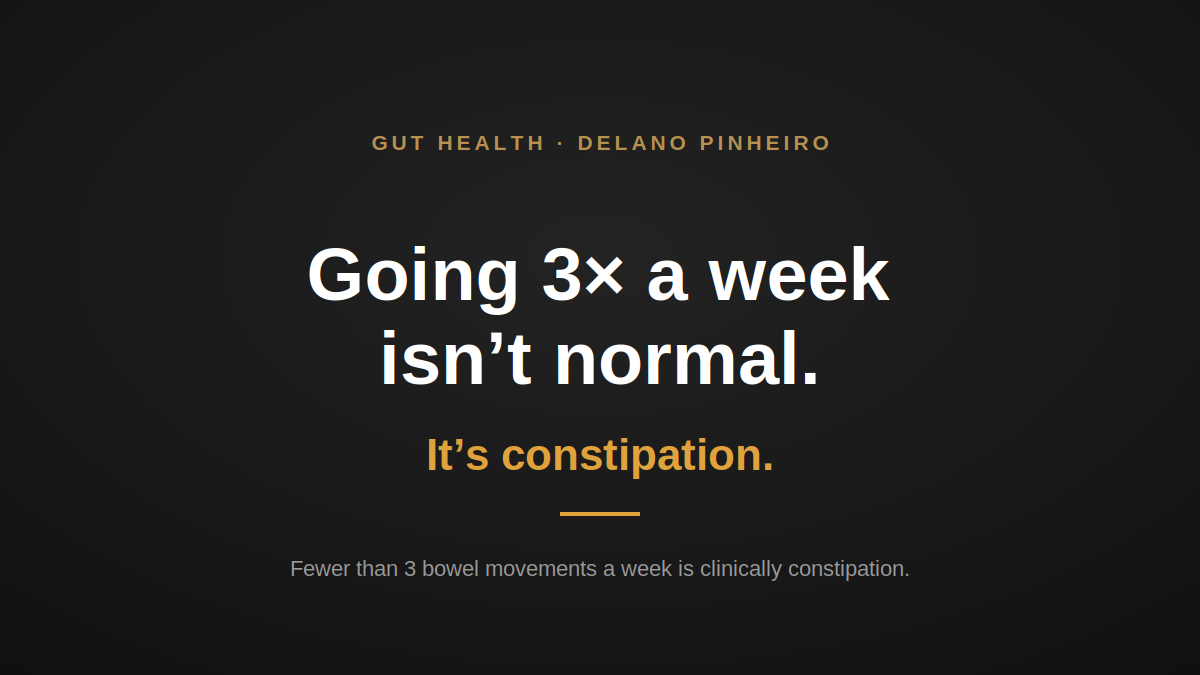
Clinically, having fewer than 3 bowel movements a week is already constipation, even if it feels completely normal to you. But here’s the point that changes everything: “not constipated” is not the goal. Scraping by at the bare minimum is surviving, not functioning well.
The healthy range is wide: anywhere from 3 times a week to 3 times a day. But for most adults, the sweet spot, the one that keeps your energy and digestion steady, is close to once a day.
And it’s not just the number. Just as important as frequency is quality: firm, complete stools, passing without straining, with the sense that you actually emptied. Going every day but with effort, hard and dry and feeling like something’s left behind, is also a red flag.
Why this matters (especially if your calendar is full)
A sluggish gut isn’t just discomfort in the bathroom. It’s a tax you pay all day long, often without connecting the dots:
- Less energy: stalled digestion drains resources and slows you down right when you need to perform.
- Bloating and a heavy, distended belly by the end of the day, even when you barely ate.
- That feeling of “weight” and discomfort in the middle of a meeting or an important moment.
In other words: a detail you treat as trivial is quietly charging a toll on your energy and your productivity.
Why “it’s always been like this” is the trap
Your body adapts to what you repeat. When the gut spends months (or years) working slowly, that becomes the new baseline, and the baseline starts to feel normal. Getting used to something isn’t the same as it being healthy. The fact that you’ve adapted doesn’t mean everything is fine; it means the fix is overdue.
What does NOT fix it: the trendy laxative tea
I’ll be blunt, because there’s a lot of money riding on this misinformation. Laxative teas don’t cure constipation. That “relief” you feel is the gut being chemically forced, not corrected. Use it for a while and it gets lazy without the stimulus, and you build a dependence on the product to do what your body should do on its own.
Real constipation is almost never a lack of tea. And in the vast majority of cases, it isn’t a lack of medication either. It’s a lack of the basics, the stuff nobody sells, because you can’t package it in a pretty capsule.
What actually fixes it: fiber, water, and movement (in the right dose)

Less sexy than a “miracle detox,” I know. But it’s what works and holds up long term, with no rebound effect:
Fiber on your plate. Fruit, vegetables, legumes, and whole grains throughout the day. Fiber gives your gut bulk and rhythm. Increase it gradually so you don’t bloat in the process.
Water, spread out. Fiber without water does nothing: water is what keeps things soft enough to pass without strain. Drink across the day, not all at once.
Daily movement. You sit for 8 hours and your gut sits right along with you. Movement is a natural laxative, and it’s free. You don’t need a marathon: walking, getting up from your chair a few times a day, and training consistently already move the needle.
Three simple things that fit into your week. What fixes this isn’t a burst of intensity. It’s consistency.
When to see a professional
Adjusting your habits solves most cases, but not all. Seek medical advice if you notice: a sudden and persistent change in your bowel habits, blood in your stool, severe abdominal pain, unexplained weight loss, or constipation that doesn’t improve even with the changes above. This article is informational and does not replace an individual evaluation.
If you want the practical playbook (how much fiber, how to spread your water, and what movement fits a packed schedule), I put together a quick 5-minute guide.
👉 Download the free guide here: [GET THE GUIDE HERE]
Delano Pinheiro is a certified physical education professional specializing in sports nutrition, injury prevention, and body composition change. In 10 years, he has helped more than 11,000 people train efficiently and sustainably, without becoming athletes and without living at the gym. Brazilian, based in Miami.
Deixe uma resposta