What almost no one told you about how your gut actually works, and why it’s draining your energy in the middle of your day.
“But that’s just how my body works.” If you’ve ever said that about going to the bathroom only a few times a week, give me the next five minutes, because that “just how it is” is exactly the problem. Going three times a week isn’t your natural rhythm. It’s a gut that has gotten used to running badly.
First, what “normal” actually means
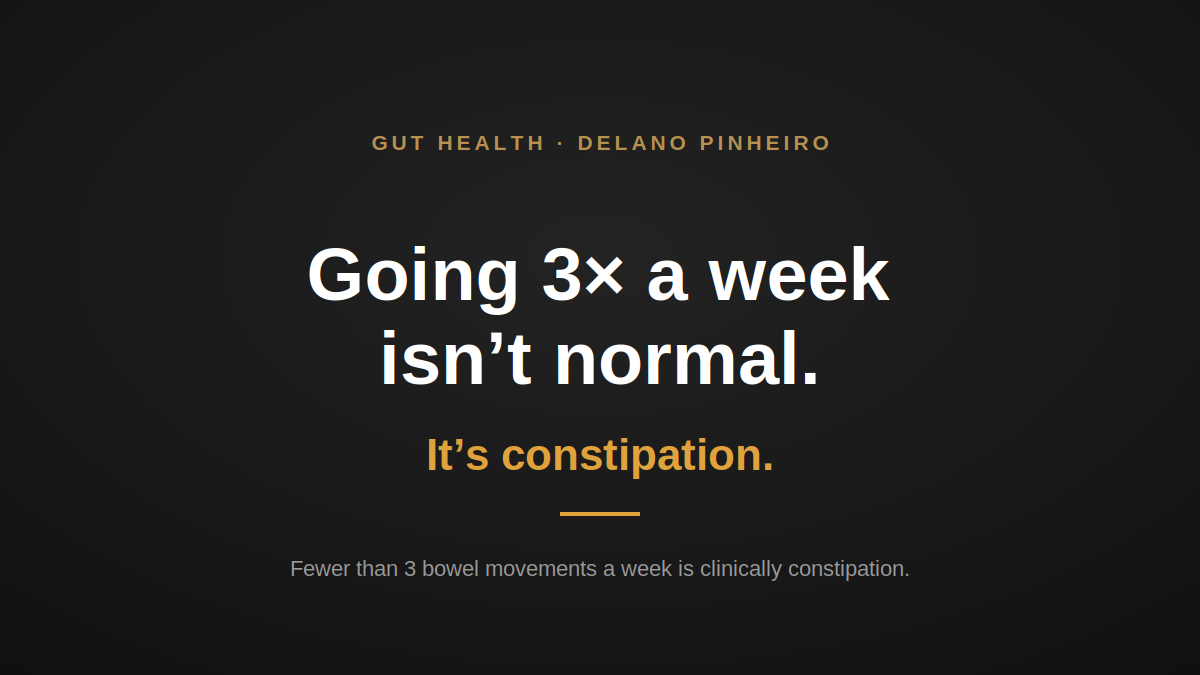
Clinically, having fewer than 3 bowel movements a week is already constipation, even if it feels completely normal to you. But here’s the point that changes everything: “not constipated” is not the goal. Scraping by at the bare minimum is surviving, not functioning well.
The healthy range is wide: anywhere from 3 times a week to 3 times a day. But for most adults, the sweet spot, the one that keeps your energy and digestion steady, is close to once a day.
And it’s not just the number. Just as important as frequency is quality: firm, complete stools, passing without straining, with the sense that you actually emptied. Going every day but with effort, hard and dry and feeling like something’s left behind, is also a red flag.
Why this matters (especially if your calendar is full)
A sluggish gut isn’t just discomfort in the bathroom. It’s a tax you pay all day long, often without connecting the dots:
Less energy: stalled digestion drains resources and slows you down right when you need to perform.
Bloating and a heavy, distended belly by the end of the day, even when you barely ate.
That feeling of “weight” and discomfort in the middle of a meeting or an important moment.
In other words: a detail you treat as trivial is quietly charging a toll on your energy and your productivity.
Why “it’s always been like this” is the trap
Your body adapts to what you repeat. When the gut spends months (or years) working slowly, that becomes the new baseline, and the baseline starts to feel normal. Getting used to something isn’t the same as it being healthy. The fact that you’ve adapted doesn’t mean everything is fine; it means the fix is overdue.
What does NOT fix it: the trendy laxative tea
I’ll be blunt, because there’s a lot of money riding on this misinformation. Laxative teas don’t cure constipation. That “relief” you feel is the gut being chemically forced, not corrected. Use it for a while and it gets lazy without the stimulus, and you build a dependence on the product to do what your body should do on its own.
Real constipation is almost never a lack of tea. And in the vast majority of cases, it isn’t a lack of medication either. It’s a lack of the basics, the stuff nobody sells, because you can’t package it in a pretty capsule.
What actually fixes it: fiber, water, and movement (in the right dose)
Less sexy than a “miracle detox,” I know. But it’s what works and holds up long term, with no rebound effect:
Fiber on your plate. Fruit, vegetables, legumes, and whole grains throughout the day. Fiber gives your gut bulk and rhythm. Increase it gradually so you don’t bloat in the process.
Water, spread out. Fiber without water does nothing: water is what keeps things soft enough to pass without strain. Drink across the day, not all at once.
Daily movement. You sit for 8 hours and your gut sits right along with you. Movement is a natural laxative, and it’s free. You don’t need a marathon: walking, getting up from your chair a few times a day, and training consistently already move the needle.
Three simple things that fit into your week. What fixes this isn’t a burst of intensity. It’s consistency.
When to see a professional
Adjusting your habits solves most cases, but not all. Seek medical advice if you notice: a sudden and persistent change in your bowel habits, blood in your stool, severe abdominal pain, unexplained weight loss, or constipation that doesn’t improve even with the changes above. This article is informational and does not replace an individual evaluation.
If you want the practical playbook (how much fiber, how to spread your water, and what movement fits a packed schedule), I put together a quick 5-minute guide.
Delano Pinheiro is a certified physical education professional specializing in sports nutrition, injury prevention, and body composition change. In 10 years, he has helped more than 11,000 people train efficiently and sustainably, without becoming athletes and without living at the gym. Brazilian, based in Miami.
If you have crossed the line of the 35s, you’ve probably noticed that the same workouts that once leaned you out now don’t give you the same results as once did.
The late nights, drinks, and lack of sleep that barely affected you at 25 now seem to impact your energy, workouts, and recovery for days.
Sleeping fewer hours and noticing that it impacts your energy, appetite, recovery, and motivation far more than it once did.
Struggling to balance going to the gym with the demands of your career, family, responsibilities, and everyday stress.
The mistake most people make is assuming the solution is to “try harder.”
In reality, the model has to evolve.
Below is a structured breakdown of what changes at 35, 45, and 55
( hormonally, neurologically, metabolically, and behaviorally)
And how training should adapt at each stage.)
Age 35: The Silent Shift
For many people, 35 is not a dramatic collapse. It’s subtle. That’s why it’s tricky.
1. Testosterone and Hormonal Environment
Total testosterone in men declines roughly 1% per year starting in the early 30s. More importantly, free testosterone may drop faster due to rising SHBG (sex hormone-binding globulin). Free T is what actually interacts with tissue.
Lower free testosterone affects:
Muscle protein synthesis efficiency
Recovery speed
Drive and competitiveness
Fat distribution (more central storage)
In women, perimenopausal hormonal variability can begin as early as the late 30s, with fluctuating estrogen and progesterone affecting sleep, mood, and body composition.
This doesn’t mean you can’t build muscle at 35. It means the margin for error shrinks.
2. Recovery Capacity Is No Longer Automatic
In your 20s, you could:
Sleep 5 hours
Drink on Friday
Train hard Saturday
Recover by Monday
At 35, recovery becomes a managed resource.
Physiologically:
Growth hormone secretion during deep sleep becomes more sensitive to sleep duration.
Cortisol response to stress becomes more impactful on abdominal fat storage.
Connective tissue recovery slows slightly.
This is the age where sleep debt accumulates as visible softness.
3. NEAT Declines Without You Noticing
NEAT (Non-Exercise Activity Thermogenesis) often decreases because:
You’re more desk-bound.
You delegate physical tasks.
You drive more.
You are cognitively exhausted.
Two people can both “train 1 hour,” but the one with lower NEAT burns 300–500 fewer calories per day.
That difference alone explains why the same diet no longer works.
What Training Should Look Like at 35
3–5 resistance sessions per week
Progressive overload, but controlled volume
Prioritize sleep over adding more cardio
Structured protein intake (~0.7–1g per lb bodyweight)
Strategic carbohydrate timing around training
At 35, optimization beats intensity.
Age 45: The Stress–Recovery Equation Becomes Central
At 45, lifestyle stress is often at its peak, with more career pressure, financial responsibility, sometimes children, travels for work, and even aging parents.
Physiology now interacts strongly with chronic stress exposure.
The OMS (Organização Mundial da Saúde) is clear: even though moderate alcohol consumption is socially normalized, alcohol is a toxic substance capable of causing progressive damage, even when consumed in small amounts.
As cardiologist Eugênio Moraes emphasizes, “there is no safe dose of alcohol.” According to him, even what is considered light drinking can have long-term effects on various systems of the body, including the neurological, cardiovascular, and hepatic systems.
That’s why taking a break from alcohol can make a big difference. The benefits start within the first few days and build up week after week.
The Liver Is One of the First to Benefit
In the first few days without alcohol, the body starts a cleansing and regeneration process. One of the organs that benefits most from this break is the liver, which is responsible for metabolizing the majority of alcohol consumed.
“The liver has the opportunity to recover and reduce inflammation, which can lead to less fat accumulation in the organ, improved overall function, and regeneration of liver cells,” explains Felipe Gazoni, a physician with a postgraduate degree in nutrology.
According to nutritionist Thays Pomini, the liver’s ability to process other nutrients and toxins greatly improves, optimizing glucose production and the synthesis of essential proteins.
Better Sleep and More Energy
Speaking of regeneration, sleep also improves significantly. Many people think falling asleep after drinking is easier, but in reality, the quality of rest is worse, as alcohol fragments our REM sleep cycles (the deepest stage of sleep). So, without alcohol, sleep is restored.
By cutting alcohol, sleep becomes deeper and more restorative, which translates to more energy throughout the day. Additionally, without alcohol, levels of serotonin and dopamine (neurotransmitters related to pleasure, motivation, and mood) stabilize. As a result, people tend to wake up more energized, with greater focus, mental clarity, and less fatigue or apathy.
Impact on Metabolism and Nutrients
People who drink regularly can suffer from impaired storage of essential vitamins and minerals, leading to ongoing deficiencies.
“This can result in a number of health issues, including neurological diseases, osteoporosis, weakened immunity, vision problems, and chronic fatigue,” says Gazoni.
A month without drinking allows the body to regain this balance.
“Alcohol interferes with the absorption of B-complex vitamins, vitamin C and D, magnesium, zinc, and iron. After stopping alcohol consumption—especially when paired with a balanced diet—levels of these micronutrients begin to normalize,” confirms Pomini.
This is felt through stronger immunity and better overall health.
Visibly Healthier Skin
One of the most noticeable changes after cutting alcohol is an improvement in skin appearance, since alcohol is a diuretic, dehydrates the body, and increases systemic inflammation.
“Without alcohol, circulation, hydration, and collagen production improve. Skin becomes more radiant with fewer dark circles,” says endocrinologist Renato Zilli.
There’s also a reduction in inflammation and toxin buildup, which helps reduce redness, swelling, and even acne.
What Changes in Your Physique
Alcohol is caloric, inflammatory, and directly hinders fat burning and muscle gain.
“Weight loss after quitting alcohol isn’t just about cutting empty calories. Alcohol interferes with fat oxidation because it prioritizes its own metabolism over burning body fat,” says Pomini.
In other words, without alcohol, your body becomes much more efficient at burning fat.
Additionally, alcohol affects hormones essential for muscle growth.
“It hinders muscle recovery and lowers testosterone and growth hormone (GH) levels. Without alcohol, people perform better, build more muscle, and stay more focused during workouts,” adds Zilli.
“Muscle hypertrophy also accelerates significantly,” confirms Pomini.
Your Heart Thanks You Too
The cardiovascular system also feels the positive effects. As cardiologist Eugênio Moraes explains, regular alcohol consumption can lead to arrhythmias, high blood pressure, and even alcoholic cardiomyopathy, a form of heart failure caused by alcohol toxicity.
“When you drink moderately but regularly, these issues can arise in the cardiovascular system. But if you stop drinking, there’s no short-term harm,” he says.
One of the clearest benefits is lower blood pressure. Alcohol can raise blood pressure, increasing the risk of hypertension, which is one of the main risk factors for heart attack and stroke. By quitting, the heart starts to work more efficiently, with improved heart rate and lower risk of arrhythmias.
A OMS (Organização Mundial da Saúde) é clara: ainda que o consumo moderado de álcool esteja socialmente normalizado, a bebida é uma substância tóxica, capaz de causar danos progressivos mesmo quando consumida em pequenas quantidades.
Como destaca o cardiologista Eugênio Moraes, “não existe dose segura para o álcool”. Segundo ele, mesmo o consumo considerado leve pode ter repercussões ao longo do tempo em diversos sistemas do corpo, incluindo o neurológico, o cardiovascular e o hepático.
É por isso que uma pausa no álcool pode fazer diferença. Os efeitos benéficos começam nos primeiros dias e se acumulam semana após semana.
Fígado é um dos primeiros a sentir os benefícios
Logo nos primeiros dias sem álcool, o corpo inicia um processo de limpeza e regeneração. Um dos órgãos que mais sente essa pausa é o fígado, responsável por metabolizar a maior parte do álcool consumido.
“O fígado tem a oportunidade de se recuperar e reduzir a inflamação, o que pode levar à diminuição do acúmulo de gordura no órgão, melhorando sua função geral e ajudando na regeneração de células hepáticas”, explica Felipe Gazoni, médico pós-graduado em nutrologia.
Segundo a nutricionista Thays Pomini, a capacidade do fígado de processar outros nutrientes e toxinas melhora bastante, otimizando a produção de glicose e a síntese de proteínas essenciais.
Melhora do sono e da disposição
Falando em regeneração, o sono também melhora sensivelmente. Muita gente acredita que dormir após beber é mais fácil, mas a verdade é que o o descanso é de qualidade inferior, pois ele fragmenta nossos ciclos de sono REM (o sono mais profundo). Por isso, sem o consumo de álcool, o sono se restaura.
Ao interromper o consumo, o sono se torna mais profundo e reparador, o que se reflete em mais energia ao longo do dia. Além disso, sem o álcool, os níveis de serotonina e dopamina (neurotransmissores ligados ao prazer, motivação e humor) se estabilizam. Com isso, a pessoa tende a acordar mais disposta, com mais foco, clareza mental e menor sensação de cansaço ou apatia.
Impacto sobre metabolismo e nutrientes
Quem bebe regularmente pode sofrer com o armazenamento inadequado de várias vitaminas e minerais essenciais, o que acarreta deficiência contínua. “Isso pode resultar em uma série de problemas de saúde, incluindo doenças neurológicas, osteoporose, imunidade comprometida, problemas de visão e fadiga crônica”, fala Gazoni
Um mês sem beber permite que o corpo recupere esse equilíbrio. “O álcool interfere na absorção de vitaminas do complexo B, vitamina C e D, magnésio, zinco e ferro. Após cessar o consumo de álcool, especialmente quando combinado com uma alimentação equilibrada, os níveis desses micronutrientes começam a se normalizar”, garante Pomini. Isso pode ser sentido por meio de uma imunidade mais forte e uma melhora da saúde geral.
Pele visivelmente mais bonita
Uma das mudanças mais perceptíveis para quem corta o álcool é a melhora na aparência da pele, já que a bebida é diurética, desidrata e aumenta a inflamação sistêmica. “Sem o álcool, melhora a circulação, a hidratação e a produção de colágeno. A pele fica com mais viço e menos olheiras”, diz o endocrinologista Renato Zilli.. Também há redução da inflamação e das toxinas acumuladas, o que ajuda a amenizar vermelhidão, inchaços e até acne.
O que muda no “shape”
O álcool é calórico, inflamatório e prejudica diretamente a queima de gordura e o ganho de massa muscular. “O emagrecimento após parar de beber não é apenas uma questão de calorias vazias eliminadas. O álcool interfere na oxidação de gorduras, pois prioriza seu próprio metabolismo em detrimento da gordura corporal”, diz Pomini. Ou seja, sem álcool, o corpo se torna muito mais eficiente em queimar gorduras.
Além disso, o álcool afeta hormônios fundamentais para o crescimento muscular. “Ele atrapalha a recuperação muscular, além de reduzir os níveis de testosterona e GH. Sem ele, a pessoa melhora o rendimento, o ganho de massa e o foco no treino”, complementa Zilli. “A hipertrofia muscular também se acelera significativamente”, garante Pomini.
Coração também agradece
O sistema cardiovascular também sente os efeitos positivos. Como explica o cardiologista Eugênio Moraes, o consumo regular de álcool pode favorecer arritmias, hipertensão arterial e até miocardiopatia alcoólica, uma forma de insuficiência cardíaca causada pela toxicidade do álcool. “Quando você bebe de forma moderada, mas regular, você pode ter essas afeições do sistema cardiovascular. Mas se você interromper o consumo, não terá um prejuízo no curto prazo”, diz.
Um dos benefícios mais claramente sentidos tem relação com a redução da pressão arterial. O álcool pode aumentar a pressão, favorecendo o desenvolvimento da hipertensão, que é um dos principais fatores de risco para infarto e AVC. Ao interromper o consumo, o coração passa a trabalhar com mais eficiência, com melhora da frequência cardíaca e menor risco de arritmias.
Fontes: Eugênio Moraes, médico pela FMUSP (Faculdade de Medicina da Universidade de São Paulo), cardiologista e doutor pelo Incor (Instituto do Coração); Felipe Gazoni, médico nutrólogo, pós-graduado pela Abran (Associação Brasileira de Nutrologia) em obesidade e sarcopenia; Thays Pomini, nutricionista pós-graduada em nutrição estética e esportiva, em nutrição fitoterápica e em genética e epigenética; Renato Zilli, endocrinologista, membro da Sociedade Brasileira de Endocrinologia e Metabologia e do corpo clínico do Hospital Sírio Libanês.
Have you ever found yourself looking in the mirror and thinking: I need to gain muscle and lose that extra fat, but where do I start? There’s a popular divide of ideas that insists you must choose: eithergainmusclefirstor burn fat.
But, truth be told, these two processes aren’t enemies but rather allies in building the body you desire. So, do you want a straightforward answer?
Then, keep reading! In this article, we’ll uncover which of these goals you should tackle first and how to balance these two crucial points in your physical transformation. Let’s dive in!
Gaining Muscle and Burning Fat at the Same Time?
There’s a widespread belief that to gain muscle, you need to be in a caloric surplus, meaning consuming more calories than you burn. Conversely, to burn fat, it’s said that you need to be in a caloric deficit, meaning burning more calories than you consume.
This is the traditional paradigm of weight loss and muscle gain. But reality may be a bit more complex and flexible than that, making it possible to gain muscle and lose fat simultaneously.
With a proper and focused training program, along with a balanced and nutrient-rich diet, it’s possible to achieve both goals simultaneously. This is because resistance training can stimulate muscle growth even in a neutral or deficit calorie state, as long as you’re consuming enough protein.
At the same time, a balanced diet and proper training can increase your metabolism, helping you burn more calories and consequently fat. So instead of thinking in terms of “either this or that,” consider the “this and that” approach to balance gaining muscle and losing fat.
Strategies Based on Individual Needs
As your body gets used to the training regimen, advancements tend to be more subtle, which may trigger the impression that the results are no longer as significant and tangible.
The body’s adaptation effects to physical exercise are a common physiological phenomenon and do not necessarily signal progress stagnation but may require strategy reformulation.
In this scenario, meal planning emerges as a powerful tool that, if properly explored, can drive progress towards individual goals. Adopting strategies involving macronutrient manipulation, for example, can be extremely effective.
With this approach, careful control of protein, carbohydrates, and fat intake can be adjusted to favor muscle gain or fat burning, depending on individual needs. If the goal is hypertrophy, an increase in protein consumption may be indicated, essential for muscle tissue repair and growth.
On the other hand, if the goal is to reduce body fat percentage, adjusting carbohydrate and fat intake may favor the use of body fat reserves as an energy source. In general, what matters is that the approaches are individualized, taking into account the particularities and goals of each individual.
Approaches for Different Scenarios
With this in mind, there’s a need for different approaches for different scenarios. If you’re above your ideal weight, the recommended strategy is to focus on exercises that involve large muscle groups.
The reason behind this guidance lies in the direct relationship between the number of muscles activated during physical exercise and the energy expenditure of that exercise.
Therefore, by performing movements that engage large muscle areas, such as running, swimming, or resistance exercises, you’re increasing the number of calories burned during training, favoring fat loss, and aiding in weight control.
On the other hand, if you’re underweight, it’s advisable to focus on gaining muscle mass. In this scenario, the strategy involves strength and resistance exercises that stimulate muscle fibers to grow, strengthen, and densify, leading to an increase in muscle mass.
Protein-rich foods are also important in this process, as they provide the necessary nutrients for muscle construction and maintenance. However, it’s important to be careful not to favor excessive fat gain, which can occur if caloric intake exceeds energy expenditure.
Should I Focus on Gaining Muscle First or Burning Fat?
In conclusion, it’s crucial to seek a balance between gaining muscle and burning fat to achieve a healthy and aesthetically pleasing body composition. Regardless of your goal – whether it’s gaining muscle, losing fat, or both – adopt an individualized approach that considers your needs and uniqueness.
Guidance from a qualified professional such as a personal trainer can be extremely helpful in defining a training and nutrition plan tailored to your goals and physical characteristics.
Although the process takes time and dedication, remember that your efforts will be rewarded with the results achieved. So, maintain consistency, patience, and persistence on your journey towards physical improvement.
Do you go to the gym, eat well and still not get the expected results? Something you are doing is wrong. Let me analyze what can be improved in your routine and you will have incredible results with a plan made especially for you in terms of exercise and nutrition.
Você já se pegou olhando no espelho e pensando: preciso ganhar músculos e perder aquela gordurinha, mas por onde começo? Há uma divisão popular de ideias que insiste que você deve escolher: ouganhamassamuscularprimeiro ou queima gordura.
Mas, verdade seja dita, estes dois processos não são inimigos, mas sim aliados na construção do corpo que você deseja. Portanto, você quer uma resposta direta?
Então, continue a leitura! Neste artigo, descobriremos qual desses objetivos você deve enfrentar primeiro e como equilibrar esses dois pontos tão importantes na sua transformação física. Vem comigo!
Ganhar massa muscular e queimar gordura ao mesmo tempo?
Há uma crença generalizada de que, para ganhar massa muscular, você precisa estar em um superávit calórico, ou seja, consumir mais calorias do que queima. Em contrapartida, para queimar gordura, dizem que é necessário estar em déficit calórico, ou seja, queimar mais calorias do que consumir.
Este é o paradigma tradicional de perda de peso e ganho muscular. Mas a realidade pode ser um pouco mais complexa e flexível do que isso, tornando possível ganhar massa muscular e perder gordura ao mesmo tempo.
Com um programa de treinamento adequado e focado, juntamente com uma dieta balanceada e rica em nutrientes, é possível alcançar ambos os objetivos simultaneamente. Isso porque o treinamento de resistência pode estimular o crescimento muscular mesmo em um estado calórico neutro ou até mesmo em déficit, desde que você esteja consumindo proteína suficiente.
Ao mesmo tempo, uma alimentação balanceada e um treino adequado podem aumentar seu metabolismo, ajudando você a queimar mais calorias e, consequentemente, gordura. Por isso, em vez de pensar em termos de “ou isso ou aquilo”, considere a abordagem “isso e aquilo” para equilibrar a ganhar músculos e perder gordura.
Estratégias conforme as necessidades individuais
Ocorre que, à medida que seu corpo se habitua ao regime de treinos, os avanços tendem a ser mais sutis, o que pode desencadear a impressão de que os resultados já não são tão significativos e palpáveis.
Os efeitos de adaptação do organismo ao exercício físico são um fenômeno fisiológico comum, e não sinalizam necessariamente a estagnação do progresso, mas podem demandar a reformulação de estratégias.
Neste cenário, o planejamento alimentar surge como uma poderosa ferramenta que, se devidamente explorada, pode impulsionar o avanço rumo aos objetivos individuais. A adoção de estratégias que envolvem a manipulação de macronutrientes, por exemplo, pode ser extremamente efetiva.
Com esta abordagem, o controle criterioso do consumo de proteínas, carboidratos e gorduras pode ser ajustado para favorecer o ganho de massa muscular ou a queima de gordura, conforme as necessidades individuais. Se o objetivo for a hipertrofia, poderá ser indicado um aumento no consumo de proteínas, essenciais para a reparação e crescimento do tecido muscular.
Por outro lado, se a meta for a redução do percentual de gordura corporal, um ajuste na ingestão de carboidratos e gorduras pode favorecer a utilização das reservas de gordura do corpo como fonte de energia. De forma geral, o que importa é que as abordagens sejam individualizadas, levando em consideração as particularidades e objetivos de cada indivíduo.
Abordagens para diferentes cenários
Com isso em mente, surge a necessidade de abordagens distintas para diferentes cenários. Se você se encontra acima do peso ideal, a estratégia recomendada é focar em exercícios que envolvam grandes grupos musculares.
O motivo por trás desta orientação está na relação direta entre a quantidade de músculos ativados durante um exercício físico e o gasto energético deste exercício.
Portanto, ao realizar movimentos que engajem grandes áreas musculares, como corrida, natação ou exercícios de resistência, você está aumentando a quantidade de calorias queimadas durante o treino, favorecendo a perda de gordura e auxiliando no controle de peso.
Por outro lado, se você se encontra abaixo do peso, é recomendável focar no ganho de massa muscular. Neste cenário, a estratégia envolve exercícios de força e resistência que estimulam as fibras musculares a crescerem, fortalecerem e se densificarem, levando a um aumento de massa muscular.
Alimentos ricos em proteínas também são importantes neste processo, pois fornecem os nutrientes necessários para a construção e manutenção do músculo. No entanto, é importante ter cuidado para não favorecer o aumento excessivo de gordura, o que pode ocorrer caso a ingestão calórica seja maior que o gasto energético.
Devo focar em ganhar massa muscular primeiro ou queimar gordura?
Em conclusão, é fundamental buscar o equilíbrio entre o ganho de massa muscular e a queima de gordura para alcançar uma composição corporal saudável e esteticamente agradável. Independentemente do seu objetivo – seja ganhar músculos, perder gordura ou ambos – adote uma abordagem individualizada, que considere suas necessidades e singularidades.
A orientação de um profissional qualificado como, um personal trainer, pode ser extremamente útil na definição de um plano de treinamento e nutrição adequado às suas metas e características físicas.
Embora o processo demande tempo e dedicação, lembre-se que o esforço será recompensado com os resultados obtidos. Portanto, mantenha a consistência, a paciência e a persistência em sua jornada rumo ao aprimoramento corporal.
Você vai para academia, se alimenta bem e mesmo assim não tem o resultado esperado? Algo que você está fazendo está errado. Deixa eu analisar o que pode ser melhorado na sua rotina e você terá resultados incríveis com um planejamento feito especialmente pra você nos exercícios e na alimentação.
Have you ever wondered if you really need to shell out money on supplements to achieve your healthy living and efficient workout goals? That’s a common question deserving careful consideration. Supplements can indeed be strong allies in achieving desired results and appropriate rest time.
But are they essential for everyone? In this article, we’ll move from uncertainty to conclusion, weighing the true need for supplements, what to consider when choosing them, and ultimately whether investing in them pays off for you.
Assessing Individual Supplementation Needs
The need for supplementation varies depending on your lifestyle, workout frequency and intensity, among other factors. There comes a point in your training where your body will start demanding more energy to maintain pace. This is because as you train, your body adapts and requires more stimuli to keep progressing.
Supplements can be useful at this stage to provide the necessary nutrients for proper recovery, preventing muscle catabolism, and contributing to lean muscle gain. However, it’s important to emphasize that most people don’t need supplements if they have a well-balanced diet rich in nutrients.
If you train moderately, about 3 to 5 times a week, have a work routine similar to most people, who usually spend a large part of the day sitting in front of a computer and eat healthily, allowing some indulgences on weekends, you probably don’t need a slew of supplements.
Many of these products promise the world, but remember that effective training and a balanced diet are the foundation for achieving your physical and health goals. Supplements should be used as a complement, not a substitute for proper nutrition.
Essential Supplements for a Workout Routine
Whey Protein is an essential supplement for a workout routine, especially for those aiming for muscle gain. This supplement significantly contributes to reaching the daily protein intake necessary for muscle repair and growth.
Whey Protein is a complete protein containing all essential amino acids, including BCAAs, which are essential for muscle recovery. Moreover, it’s rapidly absorbed by the body, making it an excellent post-workout option.
Creatine is one of the most studied and proven supplements to enhance performance in high-intensity, short-duration exercises. It works by increasing the availability of creatine phosphate in the muscle, which is used to produce ATP, the body’s main source of energy.
Essential Amino Acids (EAAs) are also indispensable for a workout routine. They are amino acids that our bodies do not produce and therefore must be consumed through diet or supplementation. EAAs are essential for building new muscle proteins, especially after intense training periods.
Essential Vitamins and Minerals: Foundations of a Healthy Diet
In addition to the mentioned supplements, it’s crucial to pay attention to the consumption of essential vitamins and minerals such as Vitamin D, B12, Magnesium, and Zinc.
These nutrients form the basis that shapes the integrity of our bodies at the cellular level, support immune function, aid in energy production, and play a crucial role in heart and bone health, among other key benefits.
They work together with protein to help increase strength and performance, as well as contribute to rapid muscle recovery. The ideal consumption of these vitamins and minerals can provide the basis for a truly healthy and balanced diet, perfect for optimizing workout results.
However, it should be noted that while supplementation can be beneficial, the absorption and need for vitamins and minerals vary greatly from person to person.
This means that while other supplements may not be harmful, without personalized evaluation, you may not be adequately meeting your individual needs or even consuming nutrients beyond what is necessary, which can lead to unwanted side effects.
Therefore, the basic nutrients listed – Vitamin D, B12, Magnesium, and Zinc – should remain a priority in the pursuit of fit health, as they support optimal body function and promote a better response to workouts and recovery. Always consult a nutritionist or healthcare professional for personalized nutritional advice.
Do I Really Need to Spend Money on Supplements?
In conclusion, do you really need to spend money on supplements? Yes and no. As we’ve seen, it all depends on your body and its individual needs.
Based on this information, it’s not necessarily mandatory to spend money on supplements as long as you maintain a balanced and healthy diet that provides all the essential vitamins and minerals for the body.
Each individual has unique needs, and therefore, supplementation should only be considered after careful evaluation by a healthcare professional. This ensures the adequate intake of fundamental nutrients like Vitamin D, B12, Magnesium, and Zinc, without incurring unnecessary expenses or potential health risks.
Do you go to the gym, eat well and still not get the expected results? Something you are doing is wrong.Let me analyze what can be improved in your routine and you will have incredible results with a plan made especially for you in terms of exercise and nutrition.
Você já se perguntou se realmente precisa desembolsar dinheiro em suplementos para alcançar seus objetivos de vida saudável e treinos eficientes? Essa é uma dúvida comum e que merece um olhar cuidadoso. Os suplementos podem ser fortes aliados na conquista dos resultados desejados e no tempo adequado de descanso.
Mas será que são essenciais para todos? Aqui neste artigo, partiremos da incerteza até a conclusão, ponderando a verdadeira necessidade de suplementos, o que considerar na hora da escolha e se, afinal, o investimento neles compensa para você.
Avaliando a necessidade individual de suplementação
A necessidade de suplementação variadeacordocomseu estilo de vida, frequência e intensidade de treinos, dentre outros fatores. Vai chegar um ponto em seu treinamento em que seu corpo começará a exigir mais energia para manter o ritmo. Isso ocorre porque à medida que você treina, seu corpo se adapta e precisa de mais estímulos para continuar progredindo.
Os suplementos podem ser úteis nessa fase para fornecer os nutrientes necessários para uma recuperação apropriada, evitando o catabolismo muscular e contribuindo para o ganho de massa magra. No entanto, é importante frisar que a maioria das pessoas não precisa de suplementos se tiver uma dieta bem equilibrada e rica em nutrientes.
Se você treina com uma frequência moderada, cerca de 3 a 5 vezes por semana, tem uma rotina de trabalho semelhante à maioria das pessoas, que geralmente passa grande parte do dia sentada em frente ao computador e se alimenta de forma saudável, permitindo-se alguns furos nos finais de semana, provavelmente não precisa de uma avalanche de suplementos.
Muitos desses produtos prometem mundos e fundos, mas lembre-se de que um treinamento eficaz e uma dieta balanceada são a base para alcançar seus objetivos físicos e de saúde. Suplementos devem ser usados como um complemento, e não um substituto para uma alimentação adequada.
Suplementos indispensáveis para uma rotina de treinos
O Whey Protein é um suplemento indispensável para uma rotina de treinos, especialmente para aqueles que visam o ganho de massa muscular. Este suplemento contribui significativamente para ajudar no atingimento da ingestão diária de proteínas necessárias para a reparação muscular e crescimento.
O Whey Protein é uma proteína completa que contém todos os aminoácidos essenciais, incluindo os BCAAs, que são essenciais para a recuperação muscular. Além disso, é rapidamente absorvido pelo corpo, tornando-o uma excelente opção para consumo pós-treino.
A Creatina é um dos suplementos mais estudados e comprovados para melhorar a performance em exercícios de alta intensidade e curta duração. Ela funciona ao aumentar a disponibilidade de creatina fosfato no músculo, que é usada para produzir ATP, a principal fonte de energia do corpo.
Os Essential Amino Acids (EAAs) também são indispensáveis para a rotina de treinos. Eles são aminoácidos que o nosso corpo não produz e por isso devem ser consumidos através da dieta ou suplementação. Os EAAs são essenciais para a construção de novas proteínas musculares, principalmente após períodos de treino intensos.
Vitaminas e minerais essenciais: Fundamentos da dieta saudável
Além dos suplementos mencionados, é crucial prestar atenção ao consumo de vitaminas e minerais essenciais, tais como a Vitamina D, B12, Magnésio e Zinco.
Esses nutrientes são as bases que moldam a integridade do nosso corpo a nível celular, suportam a função imunológica, auxiliam na produção de energia e desempenham um papel fundamental para a saúde do coração e dos ossos, entre outros benefícios chaves.
Eles atuam em conjunto com a proteína para ajudar a aumentar a força e o desempenho, além de contribuir para a rápida recuperação muscular. O consumo ideal dessas vitaminas e minerais pode oferecer a base de uma dieta verdadeiramente saudável e equilibrada, perfeita para otimizar os resultados do treino.
No entanto, deve-se ter em mente que, embora a suplementação possa ser benéfica, a absorção e a necessidade de vitaminas e minerais variam muito de pessoa para pessoa.
Isso significa que, embora outros suplementos possam não ser prejudiciais, sem uma avaliação personalizada, você pode não estar suprindo adequadamente suas necessidades individuais ou até mesmo consumindo nutrientes além do necessário, o que pode levar a efeitos colaterais indesejados.
Portanto, os nutrientes básicos enumerados – Vitamina D, B12, Magnésio e Zinco – devem permanecer uma prioridade na busca pela saúde fit, uma vez que sustentam a função ideal do corpo e promovem uma melhor resposta aos treinos e recuperação. Consulte sempre um nutricionista ou profissional de saúde para um aconselhamento nutricional personalizado.
Preciso realmente gastar dinheiro com suplementos?
Concluindo, é preciso realmente gastar dinheiro com suplementos? Sim e não. Como vimos, tudo depende do seu corpo e suas necessidades individuais.
Com base nessas informações, não é necessariamente obrigatório gastar dinheiro com suplementos, desde que se observe uma dieta balanceada e saudável que proporcione todas as vitaminas e minerais essenciais para o organismo.
Cada indivíduo tem necessidades únicas e, portanto, a suplementação só deve ser considerada após a avaliação cuidadosa de um profissional de saúde. Assim, garantimos a ingestão adequada dos nutrientes fundamentais, como Vitamina D, B12, Magnésio e Zinco, sem incorrer em gastos desnecessários ou potenciais riscos à saúde.
Você vai para academia, se alimenta bem e mesmo assim não tem o resultado esperado? Algo que você está fazendo está errado. Deixa eu analisar o que pode ser melhorado na sua rotina e você terá resultados incríveis com um planejamento feito especialmente pra você nos exercícios e na alimentação.
What? You don’t run? Take a moment and reflect: have you ever wondered why you reject the idea of lacing up a pair of sneakers and going for a run? Do you get out of breath? Do you feel shin pain? Do you sweat a lot? Whatever the reason, it’s understandable.
Running is an activity that puts our bodies in full operation, and for some, it may not be the most enjoyable experience. However, it’s worth remembering that running is a natural human activity and was once essential for survival.
Unfortunately, many people avoid running, whether due to lack of interest, physical discomfort, or simply succumbing to the conveniences of modern lifestyle.
While it’s tempting to give in to a sedentary lifestyle, it’s important to reconsider your relationship with running and understand that the benefits of this activity go far beyond the physical aspect. In this article, we’ll explore the reasons why running is a practice that needs to be incorporated into your routine.
Why don’t you like running?
First and foremost, it’s essential to understand the reasons behind your aversion to running. Excuses vary, from lack of time to the inherent laziness that strikes when the opportunity for exercise arises. It’s crucial to acknowledge this aversion and seek to understand it internally rather than simply accepting it.
I’m not comparing today to ancient times, but the truth is that people stopped running because the need no longer exists.
Today, even though running is unnecessary for survival, the issue at hand is that the conveniences of the contemporary world have distanced us from what is most essential—taking care of and maintaining our physical well-being, often achieved in part through the regular practice of activities like running.
Along with all the conveniences that the modern world brings us, there are also drawbacks, such as sedentary lifestyles.
Alternatives for Running Beginners
If you’re overweight and not accustomed to regular exercise, feeling some discomfort at the beginning—whether in your cardiovascular endurance or the physical impact of running—is natural.
However, it’s important to emphasize that there are beginner-friendly alternatives that can prepare your body for running. An extremely useful option is the elliptical, an exercise machine that simulates the running motion without the direct impact on knees and joints.
This can be a great option for those who are overweight or simply want to start more gradually and in a more controlled way in the world of running.
Profound Benefits of Running
Understanding and overcoming the resistance to taking the first step toward a running habit can be challenging, but carefully considering the profound benefits that running can bring to your health might be just the motivation you need.
In addition to providing an efficient way to burn calories and stay active, running also forces the body to adapt and grow, bringing a host of wonderful benefits to the entire organism:
Strengthens Bones: Running is an impact activity that helps in bone mass formation, reducing the risk of osteoporosis.
Improves Circulation: Increases blood flow, accelerating muscle recovery, and transporting nutrients and oxygen to the body’s cells.
Stimulates Creativity: The release of hormones like endorphins contributes to increased concentration and creativity.
Promotes Better Sleep and More Energy: Regular physical exercise, such as running, has been shown to be effective in regulating sleep.
Aids Problem-Solving: Increased neural connection during aerobic activities like running assists in information processing and, consequently, problem-solving.
Reduces Insulin Resistance: Once you start running, the body burns available blood sugar instead of producing more insulin, helping to maintain balanced sugar levels.
Prevents Heart Problems: Running is a fantastic cardiovascular exercise that strengthens the heart and reduces the likelihood of heart problems.
Increases Training Efficiency: If well-conditioned for running, your performance in other workouts, such as gym sessions, is likely to improve.
Improves Resting Heart Functions: Running regularly helps increase blood ejection by the heart, not only during exercise but also when you are at rest.
Various studies demonstrate the positive effects of physical activity, especially running, as an effective alternative in combating signs of depression, especially when practiced outdoors. It stimulates fat burning through increased calorie expenditure. Contrary to common belief, running strengthens the back.
This happens because, when running, various muscle groups, especially those in the legs and core, undergo a process of contraction and relaxation. The overall increase in blood circulation in these specific areas strengthens the muscles, contributing to a more robust spine.
Therefore, even though it may seem challenging, overcoming laziness and lacing up your running shoes brings lasting and profound benefits.
Run for a Healthier and Balanced Life
In conclusion, running is not just any physical activity; it’s a naturally skillful action for humans that requires regular stimulation. Whether to improve cardiovascular health, strengthen muscles, increase lung capacity, or combat stress, the health benefits of running are undeniable and significant.
Throughout this article, we’ve covered numerous benefits and reasons why you should consider running as an ally in the pursuit of a healthier and more balanced life. So, don’t hesitate; run toward a healthier and more balanced future.
Do you go to the gym, eat well and still not get the expected results? Something you are doing is wrong. Let me analyze what can be improved in your routine and you will have incredible results with a plan made especially for you in terms of exercise and nutrition.
Como assim você não corre? Pare um momento e reflita: já se perguntou por que rejeita a ideia de calçar um par de tênis e partir para uma corrida? Sente falta de ar? Sente dor na canela? Sua muito? Seja qual for o motivo, é compreensível.
A corrida é uma atividade que coloca nosso organismo em pleno funcionamento, e para alguns, pode não ser uma experiência tão agradável. No entanto, vale lembrar que correr é uma atividade natural do ser humano, e já foi fundamental para a sobrevivência.
Infelizmente, muitas pessoas evitam a corrida, seja por falta de gosto, desagrados físicos ou simplesmente por comodismo, rendendo-se às facilidades do estilo de vida moderno.
Embora seja tentador ceder ao sedentarismo, é importante reconsiderar a relação com a corrida e entender que os benefícios que essa atividade proporciona vão muito além do aspecto físico. Neste artigo, vamos explorar os motivos pelos quais correr é uma prática que precisa ser incorporada na sua rotina.
Por que você não gosta de correr?
Para começar, é fundamental entender as razões por trás da sua aversão à corrida. As desculpas são variadas, desde a falta de tempo até a inerente preguiça que ataca em momentos de possibilidade de exercício. Primeiramente, é vital reconhecer essa aversão e buscar compreendê-la internamente, ao invés de simplesmente aceitar.
Tendo em vista a evolução humana, nossos antepassados necessitavam ter um bom condicionamento físico para a própria sobrevivência, seja correndo atrás de presas em meio à caça ou escapando de predadores.
Não estou comparando os dias de hoje com os de antigamente, mas a verdade é que as pessoas deixaram de correr porque não se tem mais a necessidade.
Hoje, embora seja desnecessário correr por questões de sobrevivência, a questão que se impõe é que as facilidades do mundo contemporâneo nos afastaram daquilo que é mais essencial, que é o cuidado e a manutenção do nosso bem-estar físico, muitas vezes obtido, em parte, através da prática regular de atividades como a corrida.
Junto com todas as facilidades que o mundo moderno nos traz, tem também os pontos negativos, como o sedentarismo.
Alternativas para iniciantes na corrida
Se você está acima do peso e não está acostumado a exercícios regulares, é natural sentir um certo desconforto no início – seja na sua resistência cardiovascular ou no impacto físico da corrida.
No entanto, é importante enfatizar que existem alternativas amigáveis para os iniciantes que podem preparar seu corpo para a corrida. Uma alternativa extremamente útil é o elíptico, uma máquina de exercícios que simula o movimento da corrida, mas sem o impacto direto nos joelhos e articulações.
Esta pode ser uma ótima opção para quem está acima do peso ou simplesmente quer começar mais devagar e de maneira mais controlada a incursão no mundo da corrida.
Benefícios profundos da corrida
Entender e superar a resistência a dar o primeiro passo em direção ao hábito da corrida pode ser desafiador, mas considerar cuidadosamente os profundos benefícios que a corrida pode trazer à sua saúde pode ser exatamente o incentivo necessário.
Além de proporcionar uma maneira eficiente de queimar calorias e se manter ativo, a corrida também força o corpo a se adaptar e crescer, trazendo uma série de benefícios maravilhosos para todo o organismo:
Fortalece os ossos: A corrida é uma atividade de impacto que ajuda na formação de massa óssea, diminuindo os riscos de osteoporose.
Melhora a circulação: aumenta o fluxo sanguíneo, acelerando a recuperação muscular e o transporte de nutrientes e oxigênio para as células do corpo.
Estimula a criatividade: pela liberação de hormônios como endorfinas que contribuem para o aumento da concentração e criatividade.
Promove melhor sono e mais disposição: a prática regular de exercícios físicos como a corrida tem se mostrado eficaz na regulação do sono.
Ajuda a resolver problemas: o aumento da conexão neural durante a atividade aeróbica, como a corrida, auxilia no processamento de informações e, consequentemente, na resolução de problemas.
Diminui a resistência à insulina: uma vez que você começa a correr, o corpo queima o açúcar disponível no sangue ao invés de produzir mais insulina, ajudando a manter os níveis de açúcar equilibrados.
Previne problemas cardíacos: A corrida é um exercício cardiovascular fantástico que fortalece o coração e diminui a possibilidade de problemas cardíacos.
Aumenta a eficiência em treinos: se bem condicionado para a corrida, seu desempenho em outros treinos, como os de academia, tendem a melhorar.
Melhora as funções do coração em repouso: correr regularmente ajuda a aumentar a ejeção de sangue pelo coração, não só durante o exercício, mas também quando você está em repouso.
Vários estudos demonstram os efeitos positivos da atividade física, em especial a corrida, como alternativa eficaz no combate aos sinais de depressão, principalmente se praticada ao ar livre. Ela estimula a queima de gordura pelo aumento de gasto calórico. E, contrariando o pensamento comum, a corrida fortalece as costas.
Isso ocorre porque, ao correr, diversos grupos musculares, especialmente os das pernas e core, sofrem um processo de contração e relaxamento. O aumento da circulação sanguínea geral e nessas áreas específicas, fortalece os músculos, contribuindo para uma coluna mais robusta.
Portanto, mesmo parecendo difícil, espantar a preguiça e calçar os tênis de corrida traz benefícios duradouros e profundos.
Corra para uma vida mais saudável e equilibrada
Em conclusão, a corrida não é apenas uma atividade física qualquer, é uma ação naturalmente hábil do ser humano, que necessita deste tipo de estímulo regularmente. Seja para melhorar a saúde cardiovascular, fortalecer os músculos, aumentar a capacidade pulmonar ou mesmo para combater o estresse, os benefícios da corrida para a saúde são inegáveis e significativos.
Ao longo deste artigo, abordamos inúmeros benefícios e razões pelas quais você deve considerar a corrida como um aliado na busca por uma vida mais saudável e equilibrada. Portanto, não hesite, corra em direção a um futuro mais saudável e equilibrado.
Você vai para academia, se alimenta bem e mesmo assim não tem o resultado esperado? Algo que você está fazendo está errado. Deixa eu analisar o que pode ser melhorado na sua rotina e você terá resultados incríveis com um planejamento feito especialmente pra você nos exercícios e na alimentação.